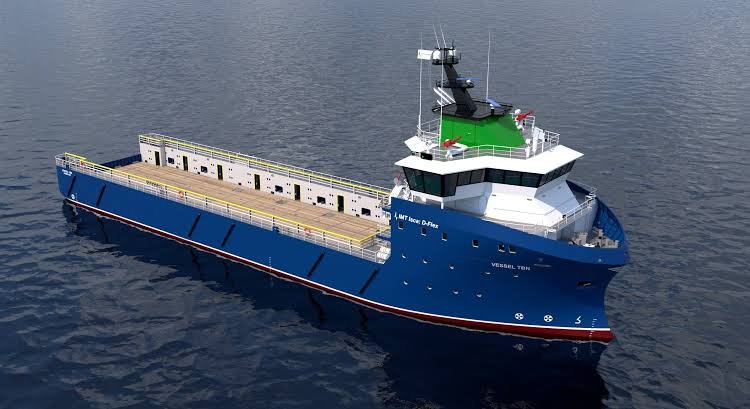
The design of a PSV vessel has a direct impact on offshore safety, operational efficiency, and cargo handling. Platform Supply Vessels must work in conditions that can be far more demanding than those faced by conventional cargo ships. They may operate near drilling rigs, production platforms, wind installations, or construction sites where space is limited and weather conditions can change rapidly. For this reason, every major element of PSV vessel design is focused on control, stability, cargo capacity, and safe offshore support.
Purpose-Driven PSV Vessel Design
A PSV vessel is designed around its offshore mission. The vessel must be capable of carrying a combination of deck cargo and bulk products while maintaining good stability in different loading conditions. Designers therefore consider deck area, tank volume, propulsion arrangement, hull dimensions, crew accommodation, and cargo transfer systems from the earliest stages.
Unlike standard freighters, PSVs frequently perform short-distance supply voyages and repeated port-to-platform cycles. Their design must support fast loading in port, efficient transit, and safe unloading offshore.
Large Open Cargo Decks
The open aft deck is one of the most recognizable characteristics of a PSV vessel. This deck can carry containers, pipes, spare equipment, machinery, and project cargo. It is normally strengthened to handle heavy loads and equipped with multiple securing points.
A well-designed cargo deck improves efficiency because the crew can arrange cargo according to unloading sequence. Items needed first can be positioned for easier access, reducing the time spent alongside an offshore installation. This is important because offshore transfer operations may be limited by weather or platform schedules.
Below-Deck Cargo Systems
A PSV vessel often carries several types of liquid and dry bulk cargo beneath the deck. Dedicated tanks may be used for fuel, potable water, drilling mud, brine, and specialized chemicals. Dry bulk tanks can carry materials such as cement or barite.
Cargo segregation is extremely important. Different fluids may not be compatible, so tanks, pipelines, valves, and pumps must be arranged carefully. Efficient transfer systems allow cargo to be pumped to the offshore platform quickly while reducing the risk of spills or contamination.
Hull Stability and Seakeeping
Offshore vessels must remain stable in rough seas and while carrying changing combinations of cargo. The hull form of a PSV vessel is therefore developed to provide suitable buoyancy, stability, and seakeeping. Designers must consider the center of gravity, deck loading, liquid tank effects, and weather conditions.
A stable platform helps the crew perform deck operations more safely and makes it easier for offshore cranes to lift cargo. Good seakeeping also reduces excessive rolling and pitching, which can damage equipment or create uncomfortable working conditions.
Dynamic Positioning Systems
Dynamic positioning has become a key feature of many modern PSV vessels. A DP system uses position references, wind sensors, motion sensors, propulsion units, and computers to keep the vessel in a selected position automatically.
This allows a PSV vessel to work close to an offshore structure without dropping anchor. The system continuously calculates the forces acting on the ship and adjusts thrusters or propellers to maintain position. Higher levels of DP redundancy can provide additional safety if one component fails.
Read Also: Event Technology for Better Attendee Experiences and Smarter Planning
Efficient Propulsion and Fuel Use
Fuel efficiency is another important part of PSV vessel design. These vessels may spend significant time in transit, maneuvering, or maintaining position offshore. Modern PSVs may use diesel-electric propulsion, variable-speed generators, hybrid batteries, or optimized thruster arrangements.
The objective is to produce only the power needed for the current operating condition. During transit, propulsion demand may be high, while during standby operations the vessel may need much less power. Flexible energy systems can reduce fuel consumption, emissions, and engine wear.
Crew Safety and Working Conditions
PSV vessel design also includes safe accommodation, bridge visibility, protected walkways, and practical machinery access. Crew members need to monitor deck operations and communicate clearly with platform personnel. Good visibility from the bridge is especially important when maneuvering close to offshore structures.
Noise, vibration, lighting, ventilation, and emergency escape routes also influence the quality and safety of the working environment. A well-designed vessel helps reduce fatigue, which is an important factor in offshore operations.
Environmental Performance
Environmental expectations are influencing new PSV vessel designs. Operators are increasingly interested in lower-emission engines, battery assistance, alternative fuels, efficient hulls, and improved waste-management systems. Some vessels can operate in port or during low-power conditions with reduced engine use.
These technologies can lower operating costs while also reducing the environmental footprint of offshore logistics.
Conclusion
An effective PSV vessel design combines cargo capacity, stability, maneuverability, propulsion efficiency, and crew safety. Every part of the vessel supports the main goal of delivering supplies reliably in challenging offshore conditions. As technology continues to improve, PSVs are becoming more efficient, automated, and environmentally responsible. For offshore operators, investing in well-designed PSV vessels can improve productivity while reducing operational risk and fuel consumption.
